The
Troop 50/55 Fifty Mile Hike of 1970
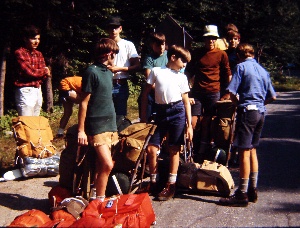 Thirteen
of us started out
from Kinsman Notch that day. In the minds of two men and
eleven boys
the
culmination of several months of planning were focused on that
trailhead and
the fortnight ahead.
Thirteen
of us started out
from Kinsman Notch that day. In the minds of two men and
eleven boys
the
culmination of several months of planning were focused on that
trailhead and
the fortnight ahead.
Our
ages
ranged from 12 to
36 (with the distribution across the group looking somewhat
like a
shepherd's
crook: /\_________). The names and photos are laid out at
http://www.thecatdragdinn.org/troop50/1970_50miler_roster.htm
(and that page, at this 45th Anniversary, is in need of
serious
updating. Please write me with
your
bio and any contact info of members of our group.) but just
for
purposes of discussion--and in no order that I remember why:
Al Oxton,
Artie
Rogers, Bill Inman, Bob Loring, Bobby Loring, Chick MacLean,
Chris
Dahl, Dave
Bagdigian, Dave Loring, Mark Hogan, Mark Pendergast, Randy
Bunny, Tony
Messina.
We were joined for the last few days by Eileen Loring and
Kathy Ahlin.
At
this
late writing there
are lots of details lost. Some others are no doubt mixed up in
order of
presentation. Mostly those discrepancies do not matter I'm
sure. What
does matter is
that we accomplished our goal. Altogether, with only one
serious
injury, no illnesses,
several faux
pas, a fortnight of good weather--arranging for that part was
quite a
strain--the Fifty Miler was a successful undertaking. If you
have
anything to
add or change in this storey please write me.
For
the
most part we
followed the Appalachian Trail from Mahoosic Notch to Pinkham
Notch.
All nights
within the bounds of the fifty miles were spent in shelter
areas
sleeping under
large poly-tarps. One night beyond the fifty mile mark, the
last night
on the
trail as we planned, was at the AMC
Mizpah
Hut. Our hike plan included
placing
several food caches up to a fortnight ahead of expected use
and one
cache that
was stored in the van of the two women who met us at Ethan
Pond Shelter.
Planning
commenced
back in
the Spring. Probly even earlier than that the event was most
certainly
part of
the annual programme plans of both Scout Troops. Overall we
tried to
involve
all the
boys in the planning and to make all decisions by consensus.
Organisation was
along the lines of a crew or team as opposed to a patrol. The
only
division
within that crew was for the purposes of cooking. We generally
slept
where we
could find space. Beyond a general description of the route,
the
details of
overnight camps, cache locations, service project areas, trash
disposal, menu,
personal equipment and prerequisites, and such plans for
emergency as
could be
made, took up most of the early planning meetings. All the
boys had to
be First
Class. This adventure took place in a time before GPS and cell
phones,
a time when boys wore shorts, when boys could think and had
common
sense. (See "The Death of Common Sense" about halfway down the
page at "Control
by Political
Correctness".
Planning
meetings.
As
individuals in the two
troops the kids and leaders had prior experience with
dehydrated and
freeze-dried foods. Despite Official Boy Scout rules to the
contrary
all the
boys were
familiar with the use of white gas stoves. We were planning to
carry
two
stoves
and enough spare parts to rebuild at least one of them. And
there were
also
lists of other spares: Bootlaces and buttons, duct tape and
electrical
tape,
bailing wire and boot grease, toilet paper and "official
strings". I
still have two of them: The Green one and the Orange one.
Our
sleeping tarps
were 16x20 foot
heavy duty poly drop cloths reinforced with duct tape. There
were two
of them
and they could be pitched just about anywhere a whole lot
easier than
tents.
There was one fairly substantial Group First Aid Kit and the
slowest
hiker
carried that and we always knew where to find him.
Personal
equipment
list
went in two directions. Some things were required. Some things
were
disallowed.
Gameboys and CD players were of course a non-issue but full
blown
messkits and
lots of extra clothing were actively discouraged. The idea was
to pack
light.
Your pack could not weigh more than a third of your body
weight and
that
included your share of the group kit. Each tripper's mess kit
consisted
of a
cup and a spoon. There was nothing on the menu that required a
fork or
a knife
however a sheath knife or a pocket knife was required.
Careful
attention
and
testing determined how much fuel was consumed to boil the
water
necessary for
breakfast and supper. Calculating from that premise we knew
how much
fuel to
carry and how much had to be stored in each cache. The same
attention
to
detail was
applied to other consumables such as toilet paper and boot
grease.
The
menu
was pretty much
the same from day to day. Breakfast consisted of three cups of
hot
water per
person, a package of instant oatmeal, a package of hot cocoa,
a package
of
"Tang" orange juice powder. The recommended procedure was to
have the
oatmeal with your first cup of hot water. When the oatmeal was
gone you
would
then add to your cup the cocoa powder and the second cup of
hot water.
The Tang
could be had with your third cup of hot water or you could mix
it cold.
Wipe
out your cup with a square of T.P. and you were ready to go.
Lunch
consisted of hard
biscuits, potted meats, cheese, apples. We had several
gallon-sized
heavy poly
drink-mix bags that were tenderly cared for. Each bag was
accompanied
by an
"Official String" used to tie it closed with a clove hitch.
Drink mix
powders were prepared as necessary for lunch and supper in
these bags;
the bags
were watched carefully lest the precious fluid leak away. I
still have
two of
the Official Strings in the galley at The Cat Drag'd Inn.
Every
supper was built
around two #10 tins of some Mountain House entre. (Mountain House foods
are
still available.) Each stove boiled a #10 tin of water and it
was then
carefully poured into the #10 tin of food product. Cover and
sit for a
few
minutes and it was ready to eat. There were never any
leftovers; empty
tins
could be used to carry trash. With the addition of a soft
steel wire
bail they
could replace the ones we used for boiling water. Granoila
bars,
chocolate,
raisins, dried bananas, rounded out the menu.
There
were
bags of gorp and
a precious supply of beef jerky for munchies along the trail.
Water was
not a
problem, plenty of that along the way.
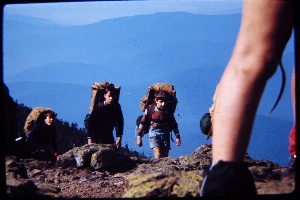
Hiking
plan.
Let the kids
sort it out. No point in trying to keep order. Everyone had a
map and
an
itinerary. We had read through the trail descriptions and knew
the
names of all
the junctions. Basically the idea was that we would all leave
camp when
everyone was ready to go. Each hiker was responsible for the
person
behind him.
You could hike in sets of any number tho it was rare that
there was
more than
two or three. But you looked over your shoulder every so often
and if
you could
not see the person behind you then you stopped and waited. You
never
passed a
trail junction alone. Usually a trail junction was cause to
regroup. In
theory
at least the leader should be able to bring the entire group
to a halt
over the
course of a half an hour without a single shout.
Shakedown
hikes
gave us
opportunity to see how all these ideas worked and at our
planning
meetings we
counted and packed all the necessary items. Per meal, per day,
per
cache.
Rations of T.P., bars of candy, boxes of raisins, packages of
oatmeal,
pints of
white gas, tins of main meals, boot grease and laces, spare
parts of
all sorts.
Everything was arranged in piles. The first pile was what we
would
carry
initially. The second pile was for the Whitehouse Bridge
Cache. Third
pile was
the Galehead Hut Cache. Fourth pile was the Ethan Pond Cache.
Fifth
pile was
the Crawford Notch Van Cache. Except for that last one each
cache
consisted of
two boxes. Meals were arranged each in their own bag packed by
day
along with
snacks and other supplies.
Putting
in
the Caches.
A
week
before the Fifty
Miler was to start, when everything had been counted and
checked and
labelled and
everyone was satisfied we would not starve we met to actually
pack the
boxes
and emplace the caches. The cardboard boxes we would use for
the caches
were
first lined with large plastic trash bags and then packed with
the day
bags. That
layer was sealed and then the fuel bottles were added to the
box and
sealed.
Then the box was double wrapped in more garbage bags. Four
boys and
myself went
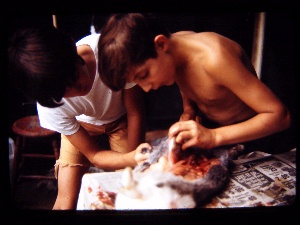
on the cache expedition. Artie Rogers, our Group First Aider,
prepared
a
special treat for supper on that trip when he butchered one of
his
rabbits and
made a stew. We were all excited. The grand adventure was
about to
commence.
The
Whitehouse Bridge Cache
was buried not too far from the trail near Whitehouse Brook
and
Whitehouse
Bridge. We would be there after three days--the third
night--on the
trail.
Whitehouse Bridge was a public carpark and picnic area where
we would
leave our
trash.
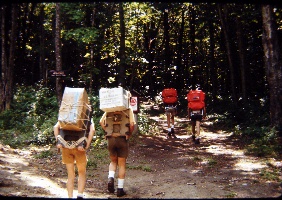
The
Galehead Hut cache was
next. After nights at Liberty Spring and Garfield Pond we
would pass by
Galehead Hut on our way to the Guyot Shelter Area. After
leaving our
cache
safely inside the hut we packed out two loads of their hut
trash so
they
would
accept our trail trash when we came through most of a week
after the
start of
our
hike.
The
third
cache was buried
in the woods behind the Ethan Pond Shelter. It would be about
a
fortnight
before we would retrieve this cache. The fourth cache would be
left in
the van
that Eileen and Kathy would bring to Crawford's when they
hiked in to
meet us at
Ethan Pond.
Fifty
Miles:
From Kinsman
Notch to Somewhat Beyond Crawford Notch.
Eliza
Brook
Shelter,
First Night.
Our
only
serious injury
happened that first night. Mark Hogan was using one of the
folding buck
saws to
prepare wood for a little campfire when the blade jumped out
of the
kerf on the
downstroke and incised his left index finger between second
and third
knuckles.
Sharp saw. Good clean cut. Right to the bone. We cleaned him
up, put on
a
butterfly plaster and a splint, and turned the firewood task
over to
someone
else. Today I have to wonder if Super Glue would
not have done
a better
job. It is amazing what some
kids will
do just to get out of chores. In the morning the wound was
clean and
looked ok.
We decided to go on.
Second
Night?
Not sure
where we were. In the vicinity of Lonesome Lake maybe? Part of
the
personal
goals of some of the trippers was to bag peaks along the way
for the
AMC 4000
Footer Award. For the most part the section of the Appalachian
Trail we
were
following went over most of them however there were a number
of peaks
off to
the side of the main trail and there were also opportunities
to
circumvent the
summits.
White
House Bridge Cache
& Camp. Third Night. First order of business was a phone
call to
Mark
Hogan's parents. The Flume Store was about half a mile south
of
Whitehouse
Bridge so whilst the group busied itself with finding the
first cache
and
setting camp Mark and I hiked south to find a public phone.
(Cell
phones had yet to be invented.) If his
parents felt
strongly that he should have professional attention at this
point then
it would
be a long drive for them to come get him. His wound had closed
and
showed no
sign of infection and in that matter they agreed with me that
we should
go on.
And so we did.
Today
I
wonder if I would
even try to get away with such first aid. I wonder if in his
turn and
in
today's litigous climate, if he would choose to let his own
son
continue with
such a hike.
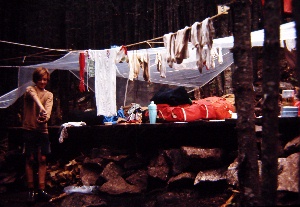
Liberty
Spring
Camp.
Fourth/Fifth Night.
Long
steep
slog, up hill
all the way. Liberty Spring had a number of tent platforms so
we strung
out our
tarps and settled in for two nights. Our primary direction was
north
but there
were two peaks, Liberty and Flume, to the south which would
make for a
short
easy hike on a layover day. It was pleasant to get out for a
walk
without the
burden of heavy packs.
Garfield
Shelter.
Sixth
Night.
North
across the Knife Edge
of the Franconia Ridge: Little Haystack, Lincoln, Lafayette,
and
Garfield. The
Franconia Ridge Trail gave way to the Garfield Ridge Trail and
the
faster boys
went on ahead to stake a claim at the shelter. Not to chase
anyone away
mind
you, "...only let them know that you are just waiting for the
other ten
kids to catch up before you start supper." By now we were
looking
forward
to our next cache and the possibility of some freshies.
Galehead
Hut
Cache and
Trash Exchange--Guyot Shelter Camp and Service Project.
Seventh &
Eighth
Nights.
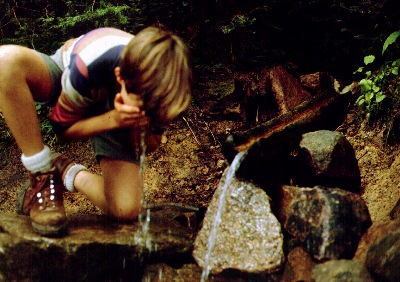 We were pretty much at
elevation now and pack weight was at a low with only trash to
carry and
a cache
ahead. Our trash for cache exchange went well and there was
opportunity
to
purchase fresh fruit before heading more or less southeast to
Mount
Guyot and
the shelter there. Along this section of the trail are
Galehead and
South Twin.
Guyot was about half way through the fifty miles and we
planned for two
or
three nights to allow plenty of time for more
peak-bagging--West Bond,
Mount
Bond, and The Cliffs--and a day for equipment maintenance and
our
service
project.
We were pretty much at
elevation now and pack weight was at a low with only trash to
carry and
a cache
ahead. Our trash for cache exchange went well and there was
opportunity
to
purchase fresh fruit before heading more or less southeast to
Mount
Guyot and
the shelter there. Along this section of the trail are
Galehead and
South Twin.
Guyot was about half way through the fifty miles and we
planned for two
or
three nights to allow plenty of time for more
peak-bagging--West Bond,
Mount
Bond, and The Cliffs--and a day for equipment maintenance and
our
service
project.
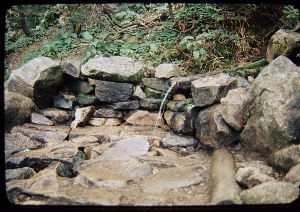
Our
service project
consisted of digging out the mud hole of a spring just below
the Guyot
Shelter
and moving around a lot of rock to improve the flow and
ameliorate the
general
nastiness. We spent some time carving out the center of a log
several
feet in
length to build an aqueduct to bring the water from the source
to a
stone basin
where the excess could drain through the stone. (It was all
pretty much
as we
left it when I next visited twenty years later.) Everything
was going
along
fine and dandy. Equipment and spirits all in good shape.
Zealand
Falls
Shopping
and Ethan Pond Camp & Cache. Ninth & Tenth Nights.
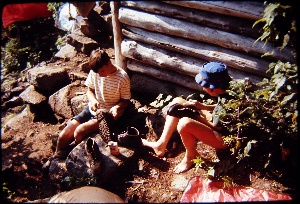
From
Guyot
Shelter the
Twinway becomes the Zealand Ridge Trail until, at a junction,
the
Zeacliff
Trail turns away towards Thoreau Falls and the Ethan Pond
Shelter. From
that
junction a few boys went on the longer loop around via Zealand
Falls
Hut to
shop for fresh fruit. Some oranges and apples would make a
nice
addition to our
dehydrated and freeze-dried diet.
At
the
Ethan Pond Shelter
another cache awaited us along with Eileen, Bob's wife and
co-advisor
of the
Explorer Section of our Scout Group, and Kathy Ahlin, one of
the
members. This
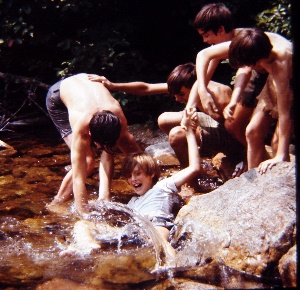
pond was large enough for a swim and there were several more
4000-footers in
the Willey Range to bag before we went on so we would stay
here two
nights.
There was a faint trace of petrol in the air when we opened
the cache
that had
lain a fortnight under the duff. None of the white
gas
bottles had
leaked,
there was no wetness, everything looked ok. But halfway
through the
first chocolate
bar we knew that some things had been contaminated.
One
didn't
notice at first.
Not until the aftertaste had a chance to work its way through
to your
conscious. The next morning the oatmeal went down fine but the
aftertaste of
gasoline lingered for hours. Every time one would burp it
would be
there
again.
I guess the lesson here is that plastic wrap, plastic bags,
poly fuel
bottles,
do not prevent the migration of hydrocarbons in that kind of a
closed
space and
close proximity. Probly only takes a few molecules to make a
noticeable
trace.
It
didn't
seem to hurt
anyone, nobody got sick, and it was only that one breky. The
tinned
meals were
ok and we would be soon out to the cache in the van which
everyone
expected
would be in much better shape. But it did turn our thoughts to
real
food and
what we each looked forward to: chocolate malts, hamburgers,
fried
chicken,
gobs of salad, fizzy soda! Watermelon!
Crawford
Notch
Van Cache
& The Big Pickle--The Nauman Shelter. Eleventh Night(?)
All
the
way down the trail,
to the highway below Crawford Notch, where the van and its
cache
awaited, the talk went
on.
Eleven salivating boys discussing their favourites whilst
knowing full
well
that only more cram and powdered drinks were on the menu for
lunch.
But!... what if
there was a watermelon waiting there? Just-- imagine for a
moment, what
if there was a cooler
of cold
drinks? What a lunch that could turn into, eh? "Nah!", Artie,
our
First Aider and Rabbit Stew Chef said, "Even if there were a
watermelon, I
wouldn't touch it. I'm tough and I'm gonna see this hike
through to the
end
before I have any watermelon." But the seed had been planted,
the
gauntlet
thrown down.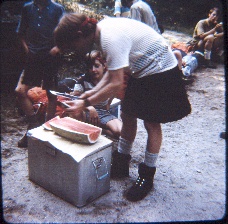
Needless
to
say there was a
watermelon. Two iced coolers of soda, ham, cheese, fresh bread
and
condiments,
and a watermelon. Artie lingered on the edge of the crowd; he
had his
honour to
defend. Finally someone said we should rename the watermelon
to a
pickle. A big
pickle. Then Artie could have a slice of pickle with his ham
sandwich
and still
save face.
Mizpah
Hut
-- Last Night
and again 13 Years Later
I
think
the steepest single
part of the whole fifty miles was the section of Webster Cliff
Trail
from
Willey House Site up to the top of the cliffs. It was a long
slog. I
don't
remember for sure if we spent that night on the trail, at the
Nauman
Shelter,
or went on to Mizpah Hut. In any case we would have been
packing light
at that
point, a minimum of food and fuel, slightly offset perhaps by
the
accumulated
dirt of nearly two weeks on the trail. Notwithstanding that,
Mizpah was
our
last night. Real food, real beds, albeit still in our sleeping
bags, and
someone
to wait on table whilst we ate from plates with forks... It
was quite a
treat.
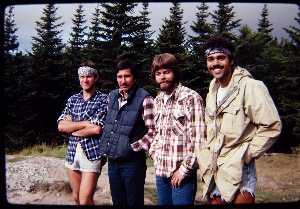
Thirteen
years
later, 1983,
some of the original thirteen scouts and leaders had a bit of
reunion
to
retrace a few of those steps and stay another night at Mizpah.
Now it
occurs to
me that we should get together again... The Summer of 2020
would be a
good
time. If not before.
Last
Day--Group
Foto and
Out Over Boote Spur to Pinkham
All
over
but the shouting
now. The group photo was the high spot of the last day and
from there
it was
all downhill, over Boote Spur, to the AMC Pinkham Notch Camp
where hot
showers
and rides home awaited.
--Emended & Expanded by ajo,
Friday, 25 December 2015
Needless to say at this point most all of 2015 slipped past
unnoticed
by all concerned. The remembering only occurred to me as I was
copying
all the slides to disk. (The collection as I have it is available on
CD.) This year would have been our 45th Reunion! Can you
believe
it?
Where have all the children gone? So many miles ago...
2020
we could do a 50th! Mizpah for dinner. Pass the word. Let's
Do! Before everyone dies.
--30--